GEO vs SEO: What's the Difference and Why Both Matter in 2026
GEO and SEO are not rivals, they are two layers of the same job. Here is what actually changed when AI started answering the questions, and what to do about it.
For twenty years the goal was simple to state: rank on Google. You wanted to be one of the ten blue links on page one, because that is where the clicks were. Then AI started answering the questions directly. Someone asks ChatGPT or Google’s AI overview for “the best yacht charter in Cabo” and gets a paragraph with two or three businesses named in it. No list of ten links. No page two. Just an answer.
That shift created a new acronym, GEO, and a lot of confusion about whether SEO is dead. It is not. But the question has genuinely changed, and if you are still optimizing only for the old one, you are competing for attention in a place fewer people look. Here is what each term actually means, where they differ, and why you need both.
What SEO has always been
Search engine optimization is the practice of getting your pages to rank in a list of results. You earn that ranking with relevant content, a technically sound site, and authority signals like backlinks. The user sees a list, chooses a link, and clicks through to your site. Everything about classic SEO is built around winning that click: the title that gets noticed, the position that gets seen, the page that converts once they arrive.
That model is not going anywhere. Billions of searches still return a list of links every day, and ranking well in that list is still one of the most valuable things a business can do online.
What GEO is
Generative engine optimization is the practice of getting your business named inside an AI-generated answer. Instead of ranking in a list, you are trying to be the source a model cites when it composes its response. The user asks a question, the AI writes an answer, and the entire game is whether your name is in it.
The mechanics are different because the output is different. A model is not sorting links, it is making a claim and attaching sources to it. To be one of those sources, it has to understand clearly what you are, trust that your information is accurate, and find your content in a form it can lift and quote. I wrote the full playbook for that in my guide to AI search optimization, but the short version is that GEO rewards clarity, structure, and consistency far more than classic SEO ever did.
The core differences
The two disciplines share a foundation, but they optimize for different moments. This is where they diverge.
| SEO | GEO | |
|---|---|---|
| The goal | Rank in the list of results | Get cited inside the answer |
| The outcome | A click to your site | A mention, sometimes a click |
| Optimizes for | Keywords and relevance | Entities and clear facts |
| Authority comes from | Links and rankings | Consistency and being quotable |
| You win by being | Higher than competitors | Clearer than competitors |
The line that matters most is the last one. Classic SEO is competitive: there are ten spots and you fight for a better one. GEO is more about certainty than position. A model will happily name three businesses in one answer, and it picks the ones it is most confident about. You are not trying to out-rank anyone so much as to be the clearest, most trustworthy option the model can point to.
Where they overlap
Here is the part most “SEO is dead” takes miss: GEO is built on top of SEO, not instead of it. The signals that make you citable are mostly the same signals that make you rank. A fast, well-structured site that Google can crawl is also one an AI can parse. Content that genuinely answers a question ranks well and also gets quoted. Authority earned through real links and mentions helps you place in the list and raises a model’s confidence in you.
You do not do GEO by abandoning SEO. You do it by adding a layer of clarity on top of work you should already be doing.
So the honest answer to “should I do GEO or SEO” is almost always both, because they are not separate projects. They are the same project optimized for two different moments: the list, and the answer.
What actually changes in your strategy
If so much overlaps, what do you actually do differently for GEO? A few things get far more important than they used to be.
The first is defining your entity. A model has to know who and where you are before it will put your name in an answer, which is why structured data moved from a nice-to-have to a core requirement. I covered exactly which signals matter in my post on schema markup for AI search. The second is consistency. Your name, address, services, and the way you describe yourself need to agree everywhere a model might check, because contradictions quietly destroy confidence. The third is writing content that is actually quotable: clear claims, clean question-and-answer structure, and direct statements a model can lift almost word for word instead of having to paraphrase and risk getting wrong.
None of this means throwing out your keyword research or your rankings reports. It means recognizing that the same page now has two audiences: the person scanning a list of links, and the model deciding whether to quote you. Good work serves both at once.
How to tell where you stand
You do not have to guess whether your site is ready for the answer era. My free AI Search Readiness checker looks at whether your entity is defined, whether your structured data is valid, and whether your content is in a form AI can actually cite, then scores it and shows you the biggest gap. It takes a few seconds and needs no signup to see the result. If your business is getting left out of AI answers entirely, my post on why ChatGPT isn’t recommending your business walks through the usual culprits.
The bottom line
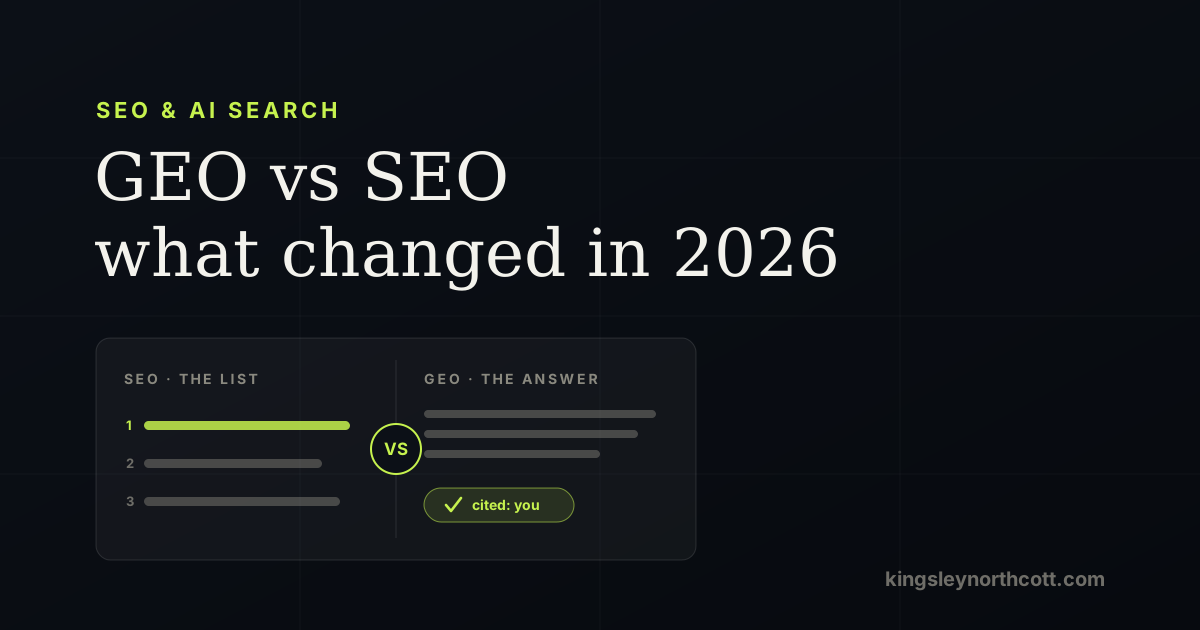
SEO gets you into the list. GEO gets you into the answer. They run on the same engine, which is a clear, fast, authoritative site that says plainly who you are and what you do. The mistake is treating them as a choice. In 2026 the search results page and the AI answer sit side by side, often on the same screen, and the businesses that win are the ones showing up in both.
Want to know how citable your site is right now? Run the free check, or if you would rather have it handled properly, that is exactly what my AI Search Optimization service is for.