
Local Citation Management: Fix the NAP Problem Costing You Rankings
Your business name, address and phone are scattered across dozens of sites, and some are wrong. Here is why that quietly hurts local rankings, and how I keep it under control.
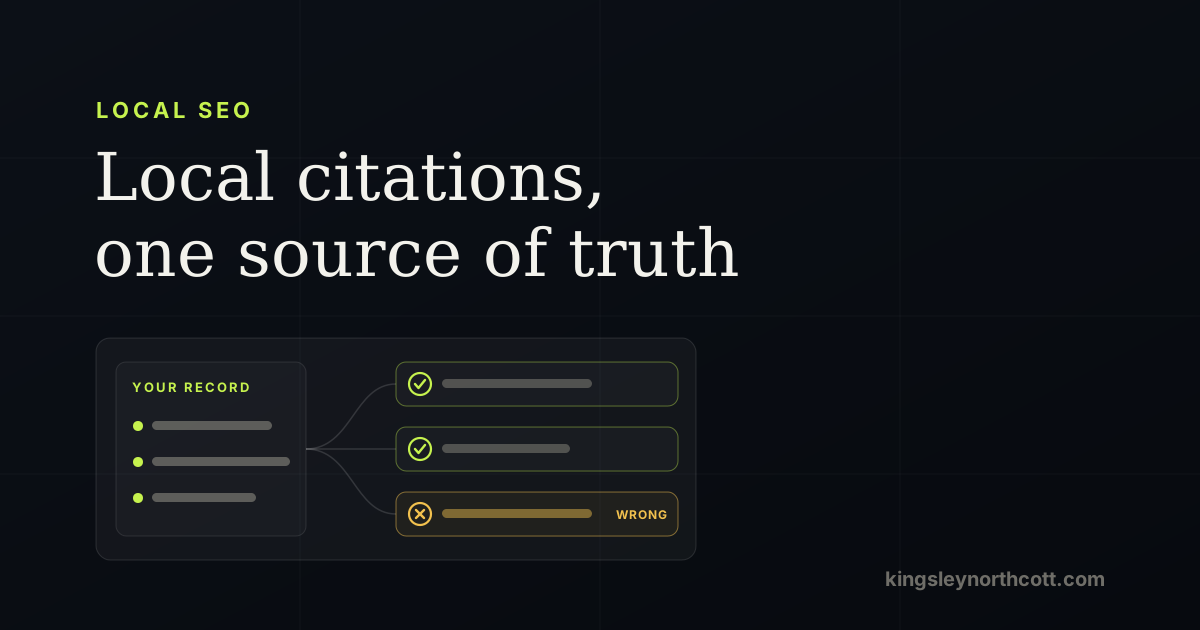
Here is a problem almost every local business has and almost none of them can see: your name, address and phone number are sitting on forty or fifty different websites right now, and some of them are wrong. An old suite number on a directory you forgot about. A phone number from two offices ago. A business name spelled three slightly different ways. You cannot see it because you never visit those pages, but Google does, and every contradiction chips away at how much it trusts you.
This is citation management, and it is one of the least glamorous and most quietly important parts of local SEO. Get it right and you build a foundation of trust that lifts everything else. Ignore it and you leave rankings and phone calls on the table without ever knowing why.
What a citation actually is
A citation is any place online that mentions your business’s name, address and phone number, the trio usually shortened to NAP. Your Google Business Profile, Yelp, the Yellow Pages, Apple Maps, industry directories, chamber of commerce listings, data aggregators most people have never heard of. Each one is a small vote that your business exists, is real, and is where you say it is.
Google leans on these votes heavily for local search, because a physical business is a real-world claim and the search engine wants corroboration before it puts you in the map pack. When your NAP is identical everywhere it looks, that claim is easy to believe. When it finds four versions of your phone number, it has to guess which one is right, and search engines do not like guessing.
The hidden cost of getting it wrong
Inconsistent citations hurt you in two directions at once, and both are expensive.
The second one is the part business owners underestimate. A wrong listing is not a neutral mistake sitting in a corner of the internet. It is an active leak, sending the exact customers you worked to attract somewhere that cannot serve them.
Why the spreadsheet approach breaks down
Most people who try to manage this reach for a spreadsheet. A tab with their business details, a list of directories, and a column for “done.” It works for about a week.
The problem is that citations are not a one-time task, they are a living system. New directories scrape your data and create listings you never made. Old information resurfaces. You open a second location, change a phone number, rebrand slightly, and now your spreadsheet is a snapshot of a reality that no longer exists. Worse, the spreadsheet has no idea what is actually live out on the web. It records what you intended to do, not what the internet currently says about you. The gap between those two is exactly where the damage lives.
Managing this by hand across a single business is tedious. Managing it across a book of clients, the way I do, is impossible to do well without a system.
How I keep it under control
A while ago I got tired of fighting spreadsheets and stale audits, so I built the tool I wished existed. It is called Placemark, and it is now how I run citation management for every local client.
The idea is simple. You keep one correct record of a business’s details, a single source of truth. Placemark then scans the web, shows you exactly where the internet disagrees with that record, and flags the listings that contradict you so you can fix them at the source. When it is time to submit or update a listing, it fills the forms from your record so you are not retyping a phone number for the hundredth time. It also keeps a ledger of backlinks and listing opportunities, so the whole picture lives in one place instead of across a dozen browser tabs and a spreadsheet that is already out of date.
The shift that matters is going from “what I meant to do” to “what the web actually says right now.” That single change is the whole game in citation management.
I am not saying you need my tool specifically. I am saying you need a system that tells you the truth about your live listings, because a spreadsheet never will. If you do local SEO for a living and you are still tracking this by hand, you are spending hours on something that should be checked in minutes, and still missing things.
A process that works, tool or not
Whatever you use, the method is the same four steps:
Establish one source of truth for the business’s exact NAP, down to the suite number and the formatting, and write it down somewhere permanent. Audit what is actually live by searching for the business across the major directories and data aggregators, noting every version that disagrees. Fix each wrong listing at the source rather than papering over it, because a correction that does not stick just reappears. Then monitor on a schedule, because new and changed listings are a constant, not a one-off. This is the unglamorous consistency work that quietly separates the businesses that own their local market from the ones that wonder why they cannot crack the map pack. If you want it handled as part of a broader strategy, that is a core piece of what my local SEO service covers.
The bottom line
Citations are a trust signal, and trust is built on consistency. Every place your NAP appears is either reinforcing that you are exactly who and where you say you are, or quietly undermining it. The businesses that win local search are not doing anything magic. They have simply made sure the internet tells one clear, correct story about them everywhere it matters.
If you manage local SEO and you want to see every place the web disagrees with your record, Placemark is free for one business, forever. Fix the leaks, and watch what the rest of your local SEO can finally do on a solid foundation.